
From being sexually/ criminally exploited by adults in public spaces, to being sexually or physically harmed by peers in their schools, young people are significantly harmed beyond their families. Historically, many of these children have been criminalised rather than protected, and despite mounting concern from governments, and efforts at structural reform, many countries still struggle to offer welfare-orientated responses that effectively target the contexts where such harm occurs.
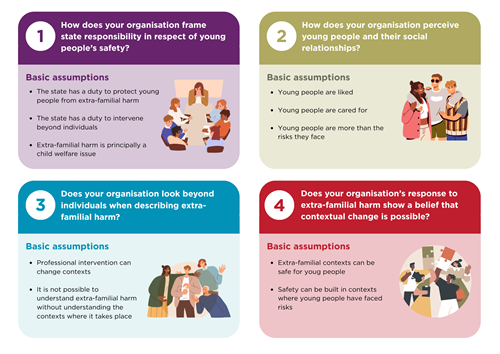
In the paper, Why ‘Common-Sense’ is Complicated: unearthing the cultural facilitators of Contextual Safeguarding structures (Firmin, C., Peace, D., and Wroe, L. 2026), we use cumulative evidence from four projects within a multiyear research programme to surface cultural factors that hinder or facilitate the development of welfare-orientated and contextual responses to extra-familial harm.
Additionally, our accompanying Organisational Culture tool is available to download and use within your own workplace.
Lastly, Professor Carlene Firmin's prestigious Kilbrandon Lecture, which she gave on this topic at Strathclyde University, is also available to watch.
All three items are linked below.