


In this blog, Dr Rebecca Brunk, a sustainability project officer at the University of Leeds, reflects and reports on an evaluation of bystander-intervention training in green spaces across six UK locations.
Following the Coronavirus pandemic, research confirmed what many people already felt: spending time in nature supported their mental and physical wellbeing. Access to parks and green spaces has been linked to improved mood, reduced stress, and greater life satisfaction, particularly for young people. But there is a missing piece in this story. To benefit from nature, everyone needs to feel safe to be there in the first place.
This is where bystander action can be a useful tool for contextual safeguarding in parks. A bystander is someone who witnesses behaviour that may be harmful or inappropriate and has the opportunity to respond. When someone receives bystander-intervention training, they learn the skills to identify harassment and how to intervene safely on behalf of someone in potential danger. This style of training emphasises that ‘everyone has a role to play’ in preventing harassment. It has been successfully utilised in workplaces, on university campuses, and in school-based settings. These are places that likely involve bystanders who would function within the neighbourhood level of Contextual Safeguarding for young women and girls. Parks are also public spaces that young people use in their everyday lives, and the consensus is that we should encourage more use of them. However, bystander training hasn’t been provided to parks staff or volunteers in the UK broadly. By understanding how park environments shape perceptions of safety, and through developing the skills of park staff, volunteers, and everyday users to identify and respond to potential danger, we can create parks that are safer for women and young people.
Understanding parks as a safeguarding context
In 2022, Dr Anna Barker at the University of Leeds explored women and girls’ experiences in parks [i]. Through discussions with 50 girls (aged 13-18) and 67 women (aged 19+) in West Yorkshire, she and her team found that although parks are meant to be open, communal spaces, many women and girls feel limited in how freely they can use these spaces because of how unsafe they feel within them. Although women reported busier parks felt safer, girls reported that men and large groups of boys made parks feel less safe. Throughout the findings, women and girls engage in what Fiona Vera-Gray refers to as everyday safety work, discussing familiarity of known safety exits, park design and lighting, and that walking around edges of parks feels safer. She has argued that women and girls often engage in this safety work by altering routes, clothing, or behaviour to manage the risk of harassment. This all correlates with the ONS Opinions and Lifestyle survey (2022) [ii], which found nearly 82% of women (and 42% of men) said they felt ‘fairly or very’ unsafe walking alone in a park or open space after dark. What this means is that these valid fears linked to experiences of harassment cause women and girls to modify their behaviour in parks. They may feel the need to be hypervigilant or avoid parks altogether, meaning that women and girls don’t get as much opportunity to experience the health and wellbeing benefits that green spaces offer.
Barker and her team suggest in their Safer Parks Guidance [iii], that one area for improvement is more ‘eyes on the park’. The phrase ‘eyes on the street’ was coined by the writer and urbanist Jane Jacobs in the 1960s to describe how safety in city streets is fostered by constant mixed activity and ‘natural proprietors’ watching over an area. Aptly named, this solution emphasises that a busy mixture of park users (particularly women and young girls) and the presence of authority figures (both park staff and CCTV) help make parks feel safer. However, the women in Barker’s study shared that they felt unable to rely on others to intervene, which reduced the helpfulness of the presence of others. Therefore, it isn’t just that there needs to be more people in parks, but that those people need the opportunity and ability to intervene. This is where our study comes in: to provide bystander training to park staff and volunteers, to upskill more people to intervene safely, and to understand if this training really does help people feel more confident and able to intervene.
Although bystander training is a promising intervention for improving support for harassment in different contexts, the research on how bystanders actually respond is more complicated. The Government Equalities Office (2020) found that nearly 40% of people had witnessed some form of sexual harassment over the last 12 months, so we know people do witness harassment happening. However, only 16% of these respondents reported taking some kind of action, and for those that did, the most common intervention was directly confronting the perpetrator. This type of intervention can be intimidating or dangerous, which might be limiting the amount of people who feel they can respond. Knowing how to respond is critical, as this report also found that people felt significantly more confident to report incidences of sexual harassment in their place of work or study (76%), places where they may have encountered some kind of guidance for reporting, than they did in outdoor public spaces such as a park. Bystander-intervention training that provides strategies for people on how to respond, particularly beyond strategies that involve confronting the perpetrator, can give more people the confidence to have an ‘eye on the park’. Further, bystander-intervention training often makes a point of ensuring men participate as part of the solution, as they can have a significant impact on helping women feel safer if they stand up to harassment. So, this training can be useful for both men and women. Given this context, we designed a training programme that supports the development of intervention skills for park staff and volunteers.
Safety is shared: the role of partners and community
Although this work wasn’t originally designed through a Contextual Safeguarding lens, it aligns closely with its goals: to improve safety for young people outside the home, by improving the contexts where harm can occur. Partnerships between public institutions, community organisations and volunteers are an essential part of Contextual Safeguarding, as they are of this research.
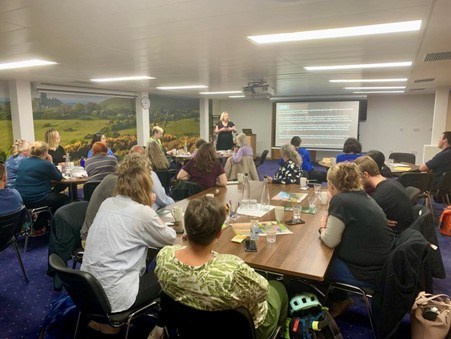
To deliver this research programme, we partnered with Keep Britain Tidy who manage the Green Flag Award standard for the management of recreational outdoor spaces across the UK and around the world. Their role in the partnership was using their network to provide the training opportunity to more than 250 people working in six locations across the UK. We also partnered with women’s safety charity the Suzy Lamplugh Trust to co-deliver training on how to detect harassment and implement bystander-intervention strategies, adapting these to park settings. Together, we created four unique harassment scenarios that might occur in a park, drawing on Barker’s research and the expertise and experiences of all our partners. From one scenario, we then adapted six different versions, based on a park in the six different regions that we provided training in, so that people receiving the training had a scenario based on a place they were familiar with.
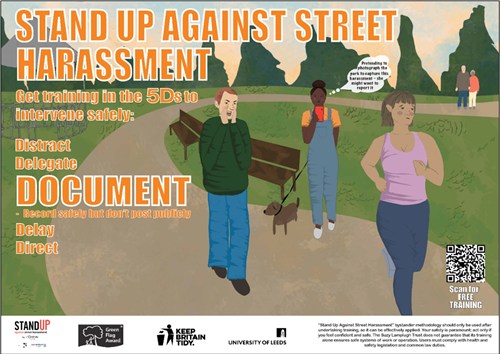
These scenarios were used as part of role-playing different parks-based scenarios, following the Stand Up Against Street Harassment programme [iv], which articulates five bystander-intervention strategies with the 5Ds framework from Right2Be to: Distract, Delegate, Document, Delay, and Direct (but only if safe to do so). These strategies give people tools to help without putting themselves at risk. This is especially important in parks, where people may be working alone or feel unsure about how others might react. Barker also presented her recommendations from her research from developing the Safer Parks Guidance, and there was space for discussion. The entire session was aimed at teaching grounds’ maintenance staff, community volunteers and park managers that action doesn’t have to mean confrontation – that changes to park design can help women and girls feel safer, and that there are a variety of ways to respond to harassment if you witness it.
Roleplay scenario: a hypothetical opportunity for bystander action in your local park
You and a friend have just finished your dog walk in the park together. You are saying your goodbyes near your friend’s car, and you hear some shouting. A group of people with their hoods up are on bikes, shouting at a group of teenage girls sitting on the playground area. You hear them shout comments about the girls’ bodies, telling the girls to “give them a wiggle”.
What do you do if you witness it?
Your safety is the priority, and so a direct approach is not advisable, you and your friend are outnumbered here.
So, one of the remaining Ds might work for you: Distract, Delay, Delegate, Document.
Training makes a difference: what the research shows
To understand if our training was having the desired effect, we designed a study that examined our participants’ confidence in using bystander-intervention strategies. We gathered responses three times: first, at baseline, before any training had been completed. Next, immediately after training had been completed and, finally, three months after training had been completed, to see how long the effects lasted.
To evaluate the training, we developed two new tools: a scale that measured bystanders’ perceived barriers to intervention (adapted from Latane & Darley’s classic model of bystander behaviour), and a scale based on the 5Ds framework that evaluated participants’ self-efficacy (or their belief that they could use this skill if the situation arose).
And what we found was promising. We saw a significant improvement in participants’ confidence after training. Across all 5Ds, participants responded that they felt more confident using these intervention skills. Barriers like "I wouldn’t know what to do" or "I’d worry what others might think" and concerns about social judgment (e.g. "I might be mistaken", or "I wouldn’t do anything if others weren’t") also significantly declined. What’s more is we saw these changes persist, even after three months. Importantly, we also found no evidence of backlash - that is, there was no indication that the training caused harm or resistance [v].
The youngest people in our (aged 18-34) training cohort, reported lower initial confidence with the intervention skills than others before they took the training, but that this confidence gap diminished after training. Because the youngest people in our training cohort had lower initial confidence, they also had more potential for improvement. This means this type of bystander training could be particularly useful for young people’s development.
Why this research matters for Contextual Safeguarding
This project is a reminder that protective factors for young people can be built into public spaces [vi]. A well-trained groundskeeper, a confident volunteer, or even a regular park user who knows what to look out for, can all be part of the safeguarding ecosystem of public greenspaces. Bystander-intervention training helps build confidence and gives people the skills they need to intervene safely, particularly when people are given the time to learn and permission to act. One participant captured the importance of this work particularly well, reflecting: "I realise that this is a start on the road to building confidence, to be able to intervene and help vulnerable women and girls."
The more people who feel equipped to recognise harassment and respond appropriately, the more we build everyday safeguarding into the public spaces young people use most.
References
[i] https://futureofparks.leeds.ac.uk/safer-parks/
[ii] Office for National Statistics. (2022, May 25). Perceptions of personal safety and experiences of harassment, Great Britain: 16 February to 13 March 2022. https://www.ons.gov.uk/peoplepopulationandcommunity/crimeandjustice/bulletins/perceptionsofpersonalsafetyandexperiencesofharassmentgreatbritain/16februaryto13march2022
[iii] Safer Parks Consortium (2023) Safer Parks: Improving access for women and girls. Report. The Safer Parks Consortium. https://eprints.whiterose.ac.uk/id/eprint/198874/8/Safer%20Parks%20-%20Full%20Guidance.pdf
[iv] Right To Be. (n.d.). Stand Up Against Street Harassment. Right To Be. https://righttobe.org/trainings/stand-up-against-street-harassment/
[v] Barker, A. and Brunk, R. (2025) Safer Parks: Fostering a Community of Active Bystanders for the UK’s Green Spaces. Report. White Rose Libraries. https://eprints.whiterose.ac.uk/id/eprint/234820/
[vi] Green Flag Award. (2025). Safer parks: A new campaign to end street harassment. https://www.greenflagaward.org/safer-parks-campaign-toolkit